Saturday, October 15, 2016

She Doesn't Know What She Doesn't Know

"There are many who hold, as I do, that the most important period of life is not the age of university studies, but the first one, the period from birth to the age of six. For that is the time when man's intelligence itself, his greatest implement, is being formed. But not only his intelligence; the full totality of his psychic powers." 
Maria Montessori: The Absorbent Mind

"Bear!" Baby says pointing toward the woods, while her father carries her down the path to buy milk from the gas station. There is no bear. However, she is convincing enough to frighten her father into spinning around and scanning the shaded tree trunks and brush for black bears. She knows bears from picture books, from soft stuffed teddies and from the pictures of panda bears, polar bears, brown, black, and grizzly bears we see in nature magazines.

"Dawwwwgeee" she says every morning when I slide open her pocket door and the dog goes in to greet her. We see so many dogs: leashed dogs, car dogs, big dogs, little dogs, sweet dogs, barking dogs, and the illustrated dogs in her books... so many fluffy, silly, droopy-tongued dawwwgeees.

"Da-deee" she calls her daddy, which she has been joyfully saying and squealing since before she reached 12 months.

"Baybee" she says, pointing to her short, round reflection.

"Mahma" she says to me now. After going off to work for a few hours, subbing in a nearby school, I return to her finally saying it, standing beside her father, pointing with pride.

"Kit-eee" she calls cats and the photographs and drawings and paintings of cats. We find cats on calendars at the grocery store, cats beneath cars in our neighborhood, cats in houses and cats in apartments... lots of cats. She likes to follow them and point and if she's close enough, she'll slap their silky backs until they run away.

She loves words just as much as she loves gravity and the sound of things crashing onto the wood floor. She loves covering her head with a blanket and running (perhaps because the game always ends with me catching her before she crashes into the coffee table). She loves reaching her fingers to the back of her mouth until her gag reflex takes over and her eyes water. She loves turning paper pages and biting cardboard pages and she loves the feel of pillows and blocks and bricks and soft noodles and shoelaces. She loves throwing a ball ("Baah") for the dog. She loves grabbing handfuls of dirt and pebbles and sand. She loves slapping the bathwater until my pants are all wet. She loves listening to her food splat on the floor and loves even more to watch the dog eat it up. She loves to sneak sticks, leaves and pine needles into her mouth. She stumbles, trips, stands and sits and would touch the whole earth if we had the time. She points and points and points, silently, waiting for me to name the object, animal or person she is staring and smiling at.

If Maria Montessori were here, she would remind me to walk slowly beside my toddling daughter as she explores the sky and ceilings above; the walls and landscapes around and the ground and floor beneath our boots or bare feet. She would remind me to be slow and patient. She'd say that she, baby, is a new person and busy with the work of natural curiosity.  She has that unconscious absorbent mind, Montessori wrote about, and she only has it until she is three years old. This time is precious. During these first years of life, she doesn't know what she doesn't know and so she spends her days, feeling her way, licking her way and babbling her way through life, stumbling into discoveries and accomplishments, which to her, are all fascinating, exciting surprises. She hunts for these experiences, satiated only when sleeping. By three years, she'll have what Maria Montessori called the conscious absorbent mind. She'll start to see that there are things she wants to learn, tasks she wants to know how to do, so she'll try then to teach herself by watching others. I'll give her lessons, but mostly she'll learn by observing and trying, fumbling, failing and succeeding.

In selfish moments, I fail to give her what she needs. I catch myself thinking that I'm the one who needs something, when really I just want it. I'm bored or busy or tired. I want us to get somewhere faster.  I want to stay sitting longer. I want her to touch her head to her pillow and immediately fall asleep. I want us to go somewhere different when she so badly needs to be right where we are. When I prevent her from doing the thing she needs to do she arches her back; digs her feet into the floor; shoves my face away from hers and she wiggles away from my hands. The first time it happened, I actually said aloud, "Oh, she's having a tantrum." It happens when she needs more time to see and touch and do something. When these moments happen, she can't move on until her senses have swallowed that knowledge. So I wait. It isn't always easy, but it is so lovely when I can sink into the slowness of presence.  Therefore, whatever she wants to do, if it is safe, I try to let her do it. She is her own explorer, discovering this life for herself, but for now I am her guide, providing maps, seat belts, snacks and a compass. 

"What an adult tells a child remains engraved on his mind as if it had been cut in marble...Since children are so eager to learn and so burning with love, an adults should carefully weigh all the words he speaks before them. A child readily obeys an adult. But when an adult asks him to renounce those instincts that favor his development, he cannot obey. When an adult demands such a sacrifice to his own personal interests, it is like attempting to stop the building of a child's teeth when he is teething. A child's tantrums and rebellions are nothing more than aspects of a vital conflict between his creative impulses and his love for an adult who fails to understand his needs. When a child is disobedient or has a tantrum an adult should always call to mind the conflict and try to interpret it as a defense of some unknown vital activity necessary for the child's development. We should remember that a child loves us and wants to obey. A child loves an adult beyond everything else, and yet the reverse is usually heard: 'How those parents love their child!' or 'How those teachers love their pupils!...' Instead, it is really the child who loves, who wants to feel an adult near him, and who delights in attracting attention to himself: 'Look at me! Stay with me!"
-Maria Montessori, The Secret of Childhood


Thursday, October 13, 2016

The American Suffragettes

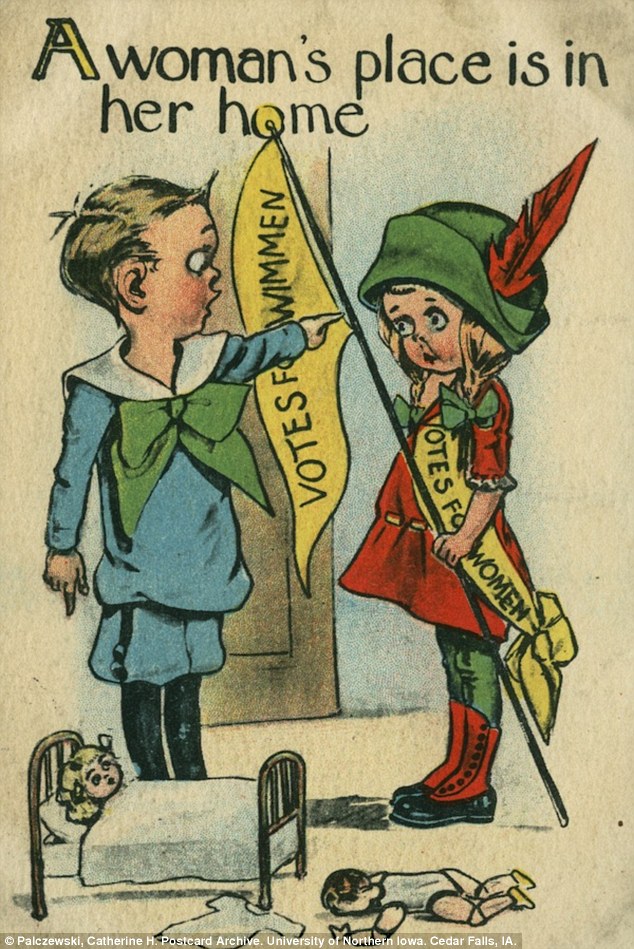
On November 8, 2016, I will carry my daughter into the voting booth with me. She'll be 14 months old. On August 18, 1920, (95 years before she was born), women in America got the vote. Before that happened, however, there were many men who tried to stop the inevitable progression toward gender equality. Below is a gallery of cowardice anti-suffrage cartoons that were drawn, printed and distributed to keep women quiet. They depict the suffragettes as either ugly old spinsters or child neglecting snobs.  These images are hostile, unfair and untrue. They are old and yet they are new.

"SUFFRAGETTES WHO HAVE NEVER BEEN KISSED." 
"ORIGIN AND DEVELOPMENT OF A SUFFRAGETTE
At 15 a little Pet.....
At 20 a little Coquette....
At 40 not married yet! .....
At 50 A Suffragette" 

"WHAT IS A SUFFRAGETTE WITHOUT A SUFFERING HOUSEHOLD?
ELECTION -DAY" 

"My wife's joined the Suffrage Movement, (I've suffered ever since!)" 

"WHAT I WOULD DO WITH THE SUFFRAGISTS" 


"IT WON'T BE LAWFUL FOR A MAN TO REMAIN SINGLE." 

"THE WILD ROSE, which requires careful handling" 


"With St. Valentine's Greetings,
To stop your tongue from wagging
There seems no mortal Law,
So we are glad, there's one thing left,
That can make you
HOLD YOUR JAW!" 

The 19th Amendment gives me, an American woman, the right to vote. I want to know who to thank for this nearly centenarian privilege so I've done a little research. Here's who I found. These are a just a few of the prominent suffragettes who picketed peacefully; spoke eloquently and passionately and were arrested, jailed and tortured for me and my rights.

But first...a palate cleanser from the foul posters above. 
"VOTES FOR WOMEN
For the work of a day,
For the taxes we pay,
For the Law, we obey,
We want something to say." 


1869: The National Woman Suffrage Association (NWSA) was formed in New York City by Elizabeth Cady Stanton and Susan B. Anthony.

"The best protection any woman can have... is courage."
-Elizabeth Cady Stanton 


1872: Susan B. Anthony, along with many other women demanded the right to vote. They were arrested. Only Anthony had a trial. She was 52 years old. 

"There never will be complete equality until women themselves help to make laws and elect lawmakers."

1884: Susan B. Anthony appeared before the Judiciary Committee of the House of Representatives to submit an amendment to the Constitution, which would give women the right to vote. 

"It was we, the people; not we, the white male citizens; nor yet we, the male citizens; but we, the whole people, who formed the Union. And we formed it, not to give the blessings of liberty, but to secure them; not to the half of ourselves and the half of our posterity, but to the whole people -- women as well as men."
-Susan B. Anthony 


Inez Milholland was a labor lawyer, an American suffragette, a public speaker and a World War I correspondent. "I am prepared to sacrifice every so-called privilege I possess in order to have a few rights." She collapsed during a speech in Los Angeles and was rushed to the hospital. She died from pernicious anemia in 1916. She was just 30 years old. Inez Milholland's last public words were, "Mr. President, how long must women wait for liberty?" 


Inez Milholland at the Woman Suffrage Parade in 1913. 


1916, Inez Milholland...the year of her death
"FORWARD OUT OF ERROR
LEAVE BEHIND THE NIGHT
FORWARD THROUGH THE DARKNESS
FORWARD INTO LIGHT" 


1913-1920: The Suffragist, a weekly newspaper, acted as a voice for the Silent Sentinels and the National Women's Party. It was started by Alice Paul and the first editor, Rheta Childe Dorr (pictured). 


1916: Alice Paul, along with Lucy Burns, started the National Women's Party after meeting in Europe and assisting Christabel Pankhurst with the British Suffrage Movement. Alice lived 92 years, spending more than half of it as a leader for the N.W.P., fighting for equal rights between the genders. She was vocal, smart, organized and brave, enduring violent arrests and imprisonments.

"It was shocking that a government of men could look with such extreme contempt on a movement that was asking nothing except such a simple little thing as the right to vote."
-Alice Paul 


1913: Alice Paul organized the Woman Suffrage Parade. Thousands of citizens from across the country gathered and walked in Washington D.C., the day before President Woodrow Wilson's inauguration. The Parade's program stated: "march in a spirit of protest against the present political organization of society, from which women are excluded" 


1917: One night, prison guards decided to make Lucy Burns an example. She was leading a hunger strike and they didn't like that very much. So they cuffed her hands to the cell bars above her head and left her there for an entire night. Fellow suffragettes joined her by holding the bars above their heads and suffering the whole night along with her. After a few days of refusing to eat, Lucy was force fed by five people. They held her down; shoved a feeding tube up her nose and watched as she bled and bled. Lucy was arrested many times for her protests. 

"It is unthinkable that a national government which represents women should ignore the issue of the right of all women to political freedom."
-Lucy Burns 


"There will never be a new world order until women are a part of it."
-Alice Paul


1917-1919: The Silent Sentinels (with the National Women's Party) picketed the White House six days a week starting in January 1917 until June 1919. They were peaceful and silent, but unjustly abused and arrested. 


"WE SHALL FIGHT FOR THE THINGS WHICH WE HAVE ALWAYS CARRIED NEAREST OUR HEARTS - FOR DEMOCRACY. FOR THE RIGHT OF THOSE WHO SUBMIT TO AUTHORITY TO HAVE A VOICE IN THEIR GOVERNMENT" PRESIDENT WILSON'S WAR MESSAGE, APRIL 2ND 1917..." 


In 1920, The 19th "Anthony Amendment" was passed, granting women the right to vote in America. Susan B. Anthony died in 1906, but her efforts and leadership have never been forgotten. 


On November 8, 2016, I will carry my daughter into the voting booth with me. There, I will vote for Hillary Rodham Clinton, America's first female nominee (of a major political party) for President of United States. It is a vote for dignity, peace, intelligence, experience and equality. It is a vote for an America where LOVE wins over puny, red-faced fear (and all its manifestations: racism, misogyny, islamophobia, elitism, violence, fascism, ignorance, ignorance, IGNORANCE). This election feels like a fight between the past and the future. And I so hope the future wins. I want this wicked past to be written into our history books, titled Never EVER Again, America, printed prominently for our children to study so that they won't repeat this massive, horrid wrong. It will take incredible willpower not to scratch out his name until there is a hole in my paper ballot and pencil markings on the table, but I will restrain myself. I want my vote to count. For I vote for every suffragette who sat in jail. I vote for every sign they held; parade they marched; and feeding tube they choked down. I vote for every letter, newspaper, speech, pamphlet, poster and amendment they wrote. I vote for every woman who saw a piece of anti-suffrage propaganda and felt unworthy, voiceless and misunderstood. I vote for my future and the future of our country. 


I can't wait to show my baby girl what liberty looks like. 

Thank you suffragettes for your stamina.

This vote is for YOU.


"The day may be approaching when the whole world will recognize woman as the equal of man."
 -Susan B. Anthony


*most of the pictures are from the wonderful Library of Congress


Sunday, October 9, 2016

There is a dead bird on our deck.


I don't let baby see. It crashed into her window the day before with that surprising and yet familiar thump, but I had forgotten to look around for it. It's either a warbler or a hairy woodpecker: black beak, black eyes and black feathers with white specks. After I put Amelia to nap, I step out onto the porch, gently, as if I might startle it alive. Its insides have been cleaned out by insects. Two black flies buzz off when I take a stick and a metal bowl's edge to the fragile bird body. It shows me its smooth red gut, which looks like a halved peach after its prickly pit has been plucked from its flesh. It's beak is sharp and still, pointing down to the planks of wood beneath it as if he is averting his eyes, afraid to see that his heart is missing. After his body flies for the last time, limply landing among the dead brown leaves in the mouth of the woods, fuzzy gray feathers stick to my bowl, which I then carry inside to soak in soap and water.

Monday, September 19, 2016

The Storm at the Chapel


In 1872, this place we live was established as a Methodist summer camp. In the center of the park, there is an outdoor chapel. It is moon white with metal, olive-green lamps dangling from its cathedral ceilings. The altar is a warm honey color. There is a center aisle and rows of dark blue benches with backs and brass commemorative plaques.

It had been hot and humid: so humid that the ants have returned to the cracks and the corners of our kitchen cabinets and counters; so hot that I was sleeping without blanket or sheet and with the fans humming in the bedroom windows. Last Sunday morning, I dressed baby in her white pants with polka dots and her pink t-shirt with the dog on it. I didn't bother her toes or soles with shoes or socks. I wore a tank top, stretchy exercise pants, sneakers and socks. I strapped her to my back and clicked the dog into her harness, collar and leash. We climbed up and across the trail behind our house, as we do most mornings. Soon, we left the leafy lumpy woods for the hard flat road. We walked for a little while then crossed the cement to enter another trail, but as we were about to reenter the woods, I noticed how dark it had become. The sky looked full of elephants: gray and heavy, blurring the tops of trees. We turned back and began hurrying home. Seconds later, the wind picked up and leaves and bits of branches began to fly and fall. I had no umbrella, not even a hat. The rain began: pattering and then pouring. We were a good distance from the house and so I ran. Baby's body bobbed with every step. Wind burst in and out of the standing trees: here, then over there, then suddenly everywhere all at once! These trees are old, enormous, wide and wise with branches as big as giraffes or sailboat masts and this wind threatened to loosen these limbs and toss them like pencils. I hurried as best I could, watching above me as I went, while also watching below me, dodging puddles in the dips of the dirt road. My skin was wet, but I wasn't cold yet. It was still quite warm.

I have so much more fear now that I am a mother. If I had been alone, I would have run all the way home, watching the sky for falling debris, but with little actual worry. But last Sunday morning, I was wearing baby and so I ran to the chapel for cover. The dog pulled us there then sniffed the legs of benches and the ground. I had never before let her in here for fear she'd piss in this sacred place, but she didn't.

We sat in the front row and waited. This storm would pass quickly. There's been a terrible drought. It would be fleeting like all the others.
.

.

.
But it lasted. Lasted a good while. I sat watching branches bend and fall in the distance as wind swirled bits of flora like living illustrations. I took baby out of her carrier and stood her on the pine floor altar. Her bare feet slapped as she sang songs of sounds and waddled side to side. Her skin didn't feel cold. She was fine. When the storm slowed, we got ready to leave, but then the sky surprised us again, sending down larger drops, drops that hurt a little when they hit. So we retreated to the back of the altar. I sat on the floor, while baby walked and the dog sat and whined and looked about. (She doesn't like loud wild wind. I don't blame her. It's easy to fear things we can't see or understand.) Baby was happy. Her voice echoed a little as she paced. She plopped down on her diapered bottom and stood and plopped down and stood. She walked in circles, opening and closing her mouth, picking up yellow pine needles and pointing at things.

I have been wanting to return to the Unitarian Church in town. I took her there when she was still sleeping most of the time. For two services, she slept, strapped to my belly, while I swayed and sung psalms; while I said hello and good morning to the other churchgoers and listened to the poems and prayers and a speech of stories by the reverend. Then she started sleeping less and less predictably during the day. Then she started napping at the time of the Sunday service. And once I had missed many months, I stopped trying, having convinced myself that I didn't care. Going out can feel like such hard work with a baby, especially going somewhere new where I should really have a couple dollars for a donation and the courage to speak with strangers. (I tend to either say nothing and smile to those I don't know, or say far too much, rambling on like a long cargo train at a street crossing.)

Every Sunday now, during the hour before the service, I worry and wonder:
Should we go?
Are we going?
I need to get her ready if we're going.
We aren't ready.
It's too late now.
I missed it again.
We'll try next Sunday.


But last Sunday morning, this blessed universe sent me to church. I wasn't dressed in my best, nor was I clean or fed, but that didn't matter. I didn't need my car or diaper bag or checkbook. This pretty little place of prayer invited us in and gave us safety and sweet gracious peace in the middle of a sudden storm.

While I sat, watching baby and listening to the sky holler and weep, I wondered about all the people who have sought refuge in houses of worship throughout human history: in cathedrals and little stone parishes, in mosques and monasteries and nunneries, in all kinds of temples and churches and sanctuaries. In this chapel beside the woods, there are no walls, except around the altar, and so the wind passes through the congregation as insects, birds, love or prayer might.

Today is Sunday again. When I awake, rain begins to wet the windows. I read, sing and yawn through picture books with baby in her bedroom, but the dog is anxious to relieve herself and so we dress. This week, I put baby in her bear hat, long sleeves, pants and sneakers. I wear the same as last Sunday, but with a sweatshirt. With baby strapped to my back; leash around my wrist, and our big umbrella in my hand, we leave the inside for the outside. The rain and wind are gentle. The air is warm. The clouds collect in a thin white canopy, letting in some of the morning light. We are slow today, strolling up and down the single lane roads. When we return, I wake up my husband by blending a banana and yogurt smoothie for baby. He comes down in his underwear, looking for tissues and his daughter's smile. I tell him I want to go to the service this morning, would he watch baby? Of course, he will. We'll all go to town, he suggests. He'll take baby for a walk and get breakfast, while I'm in church.

I am greeted at the great big door by smiling strangers, saying welcome. I write my name on a name tag and stick it to my denim jacket. Then I slide into the last row. I listen and try to sing along to songs I don't know. I close my eyes when the pianist plays and in the moment of meditation. When we are encouraged to introduce ourselves to our neighbors, a woman with short white hair turns around in front of me and says, "Good morning!" We introduce ourselves as we shake hands. "Have you been here before?" She asks.

"Yes, a couple times. I had a baby last August and I brought her when she was a tiny baby, but I haven't been back in months and months........(that cargo train I was telling you about)....my husband has the day off from work and so he's with her outside now."

"Oh well, welcome." She says. "We've been away for a couple weeks, ourselves. Just got back from the Cape."

I donate $2 to the collection and share the hard cover book of psalms with the woman to my right. I feel a peaceful gladness to be here in this space. After the service, I find my family in the park. Baby has been making friends and chasing birds, I'm told. As we walk to the car, I tell my husband about it. I'll go back and we'll go back together too, but never out of worry, only out of love and longing.

Tuesday, September 6, 2016

Between her Bedtime and Mine


Once she is asleep, I tip toe out of her room, away from her ...and toward myself.

I love these nights, these quiet dark nights. There is only a pocket door between us, but during the hours when she is sleeping, I am resting.  I am inviting solitude and selfishness to seduce me like they used to; to take me away for awhile, away from my motherhood and its obligations and attentions and worry. I wander through the house, drifting from one sitting place to another. I pen letters to my grandmother or write cards or tomorrow's grocery list. I read letters and bills and email. I take breaks from the alphabet, setting my eyes on screens, toward strangers, as they try to trick me into believing the stories they show and tell. Sometimes I take slow showers then stand in the kitchen, leaning on the counter, snacking on peanut butter toast with banana, while my hair drips down my back and my toes press into the floor as if they were kissing the earth to say, "Thank you, I am grateful for your gravity." Most nights, though, I send my mind off on journeys, my thoughts romping up and down pages, while my fingers follow tapping letter after letter after letter...

Tonight, the window behind the desk faces the black woods where the crickets, tree frogs and cicadas trill together like some far off orchestra, tuning for a concert in the trees. The lamp on the desk glows a dim gold, inviting moths to settle and dust the glass with their silky, dirty wings. The dog lies down and sighs. The highway traffic down the hill rumbles and whistles. And as the baby sleeps, I realize that it is here, within these hours between her bedtime and mine, where I feel most like a grown up.


Sunday, August 21, 2016

Tree Tree Tree


“It would be too soon for us to say: Let the children be free; encourage them; let them run outside when it is raining; let them remove their shoes when they find a puddle of water; and, when the grass of the meadows is damp with dew, let them run on it and trample it with their bare feet; let them rest peacefully when a tree invites them to sleep beneath its shade; let them shout and laugh when the sun wakes them in the morning as it wakes every living creature that divides its day between waking and sleeping. But, instead of this, we anxiously ask ourselves how we can make a child sleep after the sun has risen, and how we can teach him not to take off his shoes or wander over the meadows. Where, as the result of such restraints, a child degenerates, and, becomes irked with his prison, kills insects or small harmless animals, we look on this as something natural and do not notice that his soul has already become estranged from nature. We simply ask our children to adapt themselves to their prison without causing us any trouble.”  (Maria Montessori writes in The Discovery of the Child).


I push her in the stroller along our narrow neighborhood lanes, while Penny pulls, pees, sniffs and rolls. After awhile, we go home where I leave the carriage and the dog so that I can take baby back outside, just her and me. In a week, she'll be one. Yesterday, she walked a bit on her own and today, I want to take her to the wooded path beside our house for her first hike. She's wearing a pair of sparkly sneakers with Velcro straps, white socks, striped pants and a tank top. Not quite the attire of a Jane Goodall, Rachel Carson or Gertrude Bell, but we won't be going very far. She holds two of my fingers as we trample up and down the slight slope of golden pine needles, brown leaves and dirt. She falls and sits and crawls and finds sticks to sneak in between her teeth. She looks up and around and smiles and babbles and points. Tree. I say. Tree. Tree. I show her five tiny pinecones. Pinecone. I say. Pinecone. Pinecone. I draw in the dirt with a small Stick Stick Stick. She copies me, holding it between her fingers and carving lines into ant tunnels and worm trenches. Ohhh wind, Amelia! Wind. Wind. Feel the Wind? She wobbles as she walks, but she's fearless even after she falls and flops onto her back. Her cheeks pink as she pants from this work of walking, squatting, sitting, and standing. She pauses, plops down in the middle of the path and pinches a yellow Leaf Leaf Leaf between her fingers before tearing it to pieces. My little explorer's eyes are bright with curiosity.      


Before I birthed her, I feared Time would trick me with distortion. I worried my seconds would be swallowed by sleep or sleepy wakefulness. Worried my minutes might speed up like a Buster Keaton comedy with my beloved bloopers snipped and left to dust and boot scuffs on the 
cutting room floor. I worried the hours, days, weeks, and months might simply go missing as if stolen by the stars, sun and this rapidly spinning earth. But this still feels like a sober speed, clear and unaltered. It feels like a year since I sat at home waiting for my body to shudder and quake, to split open and push her out. It feels like a year since I introduced her to air, since the nurse propped her warm fuzzy head beneath my breast so that she could drink milk from me for the first time. A year since I bled between my legs and wept and pleaded to a room full of doctors: Why won't she come out? after her heart rate slowed and they threatened me with emergency surgery. It feels like a year of gradually lengthening limbs and the rounding of cheeks, thighs and tummy; a year of singing silly songs our sweet Lead Belly lullaby; a year of smiling, worrying, cooing and dancing. It feels like a true year. From her first social smile to belly laughs. From wet pink gums to eight white teeth.  From banana bits to blueberries, yogurt smoothies, sunny side up eggs and bread. From her first roll to sitting straight, to crawling, to standing and now to walking. This feels like an honest year because I am excited (not woeful or weepy) for her to speak syllables, words, sentences and stories; to play games with other children; to run, climb, and jump, and to sit on my lap while I read an entire stack of picture books....but I'm in no hurry. Nature leads her and I follow. It leads her up our steep staircases; leads her to crawl laps around the coffee table, and to pull tissues out of tissue boxes and clothing out of laundry baskets and balls out of her toy box.  She is absorbing her environment as Maria Montessori said she would, absorbing it like the Dirt Dirt Dirt absorbs the Rain Rain Rain.  


Monday, August 1, 2016

The Winter Garden


Snow drapes over the mountain like the finest of lace:
Tiny stitches into snowflakes of water and ice.
The storm has passed. The sun shines bright.
A rumbling truck plow breaks through the deep white,
Causing the country road to shine quite slick
Beside the little house of stone, glass and brick, 
Where the black iron stove is lit
And packed with crackling firewood, long since split.
High on the papered living room walls,
Shelves hold picture books and mystery novels,
Cookbooks, histories, dictionaries,
Pretty catalogues about birds and trees, 
Animal tracks, gardening, poetry
And maps of forest trails for exploring.

At the upright piano, Pop sits,
Pressing pedals and keys into quiet music:
Sweet, like the smell from the kitchen stove
Where Momma chops kale and red potatoes,
And sings to the baby sleeping in her belly,
While glancing at a tattered old recipe.

At the long farmhouse kitchen table,
Six-year-old, Hadley sits, so sad and dull.

“ Oh Momma, when will winter be over?
I miss the sunshine, berries and flowers.”

“It’s awhile away. Go make what you miss.”
Momma says, leaning in for a forehead kiss.

Hadley closes her eyes and pretends that she is barefoot in the garden dirt. Removes her long sleeved shirt, unlaces her boots, peels off her socks and imagines torn-up, tangled roots and muddy gray rocks. She pictures pulling weeds and planting seeds, unfurling a blanket and picnicking on cheese, bread and strawberries. She runs to the field where the breeze blows through the summer trees and tickles her naked sunburned knees. And there on the path, she sees, the flower patch with the pretty pale pink peonies for making posies! Then on her imagination goes……to the climbing vines of red tomatoes and the fragrant purple basils, the geraniums and the pointy thistles. She imagines her bathing suit pinned to the line, her black and brass bicycle, the lake, and drippy purple popsicles. She hears fireworks, tree frogs and coyote cries, sees bonfires and blinking fireflies.

Suddenly, she opens her gray speckled eyes.
Then off to her easel, she practically flies!

Hadley paints pale posies of peonies;
The blueberry bush; wild grass; pine trees.
She paints seedlings 
And feather wings, 
Shining stars, 
And insect jars, 
Green tangling vines
And warm yellow sunshine. 

Hadley paints and paints! 
Paints until she nearly faints!


Momma sits with her books and photographs,
Collecting data and drawing up graphs. 
She’s a botanist, a plant biologist, 
a professor and field scientist. 
She’s a social justice organizer,
a mom and a vegetable gardener.

Pop is a poet and a pianist.
 He’s a bee keeper and a tree arborist.
At the local elementary school, he teaches music,
English, history, art and mathematics.
He’s a dad, an animal lover,
A feminist and a book collector.
Today, he lays with his cellphone screen lit, 
Reading newspaper stories recently writ. 

Hours later, with an empty belly,
Hadley slices bread and smears it with jelly 
(The jam she and Pop made late last summer)
…And just like that, she starts to remember…

It was so hot then when Pop stood at the sink, his hand stained blue, holding a tall lemon drink. Blueberries boiled in a pot on the stove: hot fruit jam to fill jars with pretty handwritten labels. Hadley stood beside the blueberry buckets with her tongue, lips and fingers wet with blue violet. Now months later, back in the cold white winter...

Hadley prepares a cup of peppermint tea,
Turning the comb with wildflower honey.
She slathers her bread with blue jam and butter
Momma and Pop must have gone out without her! 
At the sink, she washes her dishes and sees, 
Out the window surrounded by snow and trees,
Are her sweet, precious parents, her family.  
Hadley puts the kettle back on for more tea. 

Hadley finds socks in her oak wood dresser,
Long johns and her softest sheep wool sweater. 
She wraps her scarf; ties the laces of her boots,
Puts on her knit hat and puffy snowsuit.
She buttons the buttons of her jacket;
Grabs mittens and the empty kindling basket.

Steam rises from the mugs like clouds in the wind.
When they see Hadley, her parents pause and grin. 

“Tea for you.” She says, holding out her tray.  

“Thank you! Ready for a little work and play?” 

Hadley gathers sticks from beneath spindly trees;
Fills the bird feeders with lots of little seeds;
She throws snowballs as far as she can;
Runs, tumbles, makes a fort and a silly snowman.
She sweeps the porch and brushes off the wood pile,
Shovels the garden path and wipes off the sundial.
Hadley coasts down the hill in her long, planked toboggan
Until the sun sinks behind their great pine forest mountain.

Sweaty and sleepy, Hadley lays in the snow,
Thinking about her day and the new thing she now knows: 
Even though it is late winter
And cold and windy and dark as ever,
Inside, she can be cozy, busy and happy 
And, if she wears her layers well and warmly,
The outside, too, is a delightful place to be.

43

Another journey around the glorious, gorgeous, and gracious sun. And I am ever lighter.