Thursday, March 28, 2013

Do


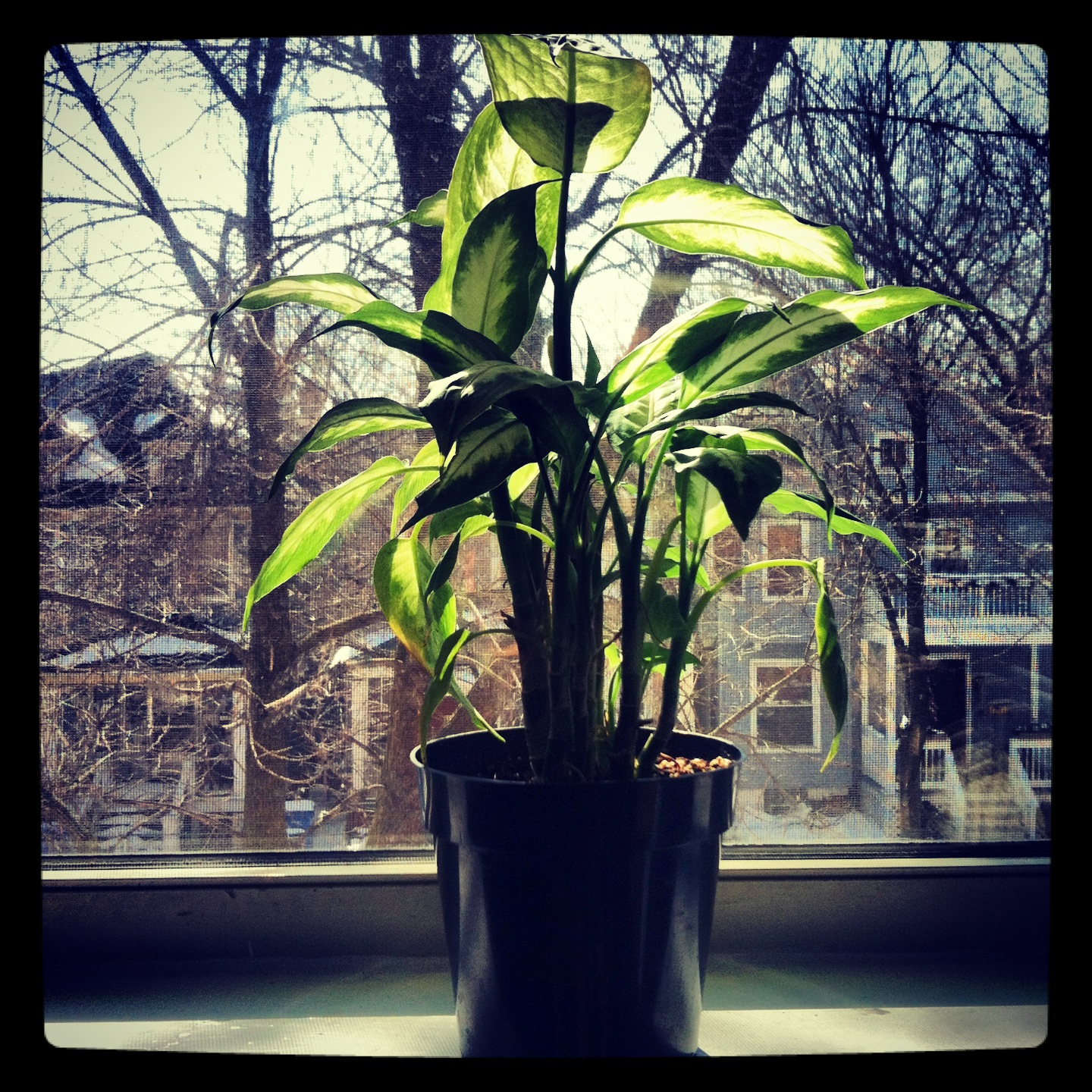
I play my guitar and sing the two songs I know for the plants and the bowl of yellow onions on the windowsill in the kitchen. They are in a spotlight of morning sun. Ready for a painter with a plain canvas. My mug of orange zest herbal tea steams on the coffee table. I pour the water from the kettle and the old floral metal pot sizzles and spits from its spout, splashing onto the gas range. I love it. I love that I rid my life of my microwave.  In the fall, I bought this granny teakettle at a second hand store in Andersonville for $2.95. Sometimes--when in a hurry--I wish we still had our microwave, but mostly I'm happy for the barer counter and for forcing myself to slow down and let the oven preheat or the stovetop warm a skillet. Someone once told me that she and her husband read an article about how microwaves change food when they heat it. Like it makes it into something else chemically. I don't know. I'm not a scientist and I never even read the article she mentioned. But I heard her say it once in the break-room at work while she waited nearly her entire break to warm her soup in the toaster oven. Why would you bring soup to work if you can't properly heat it up? I thought to myself, admiring her determination. Anyway, a couple years later, when I had my yard sale before moving to Chicago, I decided to sell our microwave. We're downsizing! I told my husband, the one I knew who would miss it more than I. But he's gotten used it. Last night he wants frozen bean enchiladas, and so he takes off the wrapper, covers it in tin foil, and places it into the preheated 350 degree oven. We take the dog for her nightly stroll and when we get home, the smell of his dinner reaches into our noses and exits our salivating glands. 

I think we all get so caught up with whatever is fastest and easiest that we miss out on doing stuff and on knowing how to do stuff. Nice every day stuff like boiling water or sweeping the floor or tracing one's finger along the inked lines of a creased paper map. 

One of my new favorite things to do is bake bread. And I had a thought recently that I should get one of those big mixers or maybe a bread maker! But then I remembered how I love to squish the ivory dough between my fingers, feeling through its texture for when to add more flour. 


Wednesday, March 27, 2013

Inside Outside


The old American Dream of having a good job that can support a family has been trampled by the designer boots my generation has charged on credit cards. The old white-picket fence family life is now called old fashioned and boring and why waste your life changing diapers when you can get on reality television or a music video with some sexy pop star? We feel compelled to be more interesting than our parents and grandparents. We don't need marriage. We say. We don't need that old-fashioned custom to tell others that we're committed to one another. She knows. He knows. Besides divorces happen all the time so it's not like people really stick with the whole, "till death do us part" bull anyway. I'd rather lead a life of cell phone photographs, job jumping and future dodging. I feel as if we were all raised to believe--not from our parents necessarily, but from other outside sources--that we must follow our dreams. That because we are all unique and so very special, we must figure out a way to share ourselves with as many strangers as possible through some artform--because the more people who know you the more important you are--and then make lots of money from it. Because we are better than "real jobs". We must chase that pretty rainbow and when we find it, we'll get our promised pot of gold.   

I think many of us miss our rainbows because we are looking for the dark crayon-colored ones we once drew as children--as if the wax crumbs will be piled on the sidewalk, a sign to look up. But now what? We are nearing thirty and we realize we are not--and will probably never be--apart of that minuscule minority who make their living as artists. I can still create for the sake of loving it. And I can go to the movies without wishing I was in the movie or at the Oscars on a plush purple chair, winking my painted eye at the camera. I can say something funny once in awhile; doesn't mean I deserve a microphone and fifteen minutes of stagetime. Why do a hobby at all if it isn't going to turn into my path, my journey to superstardom? Thank you Words--no really thank you--for that stream of thoughts from my subconscious and into sentences because then I can see--really see--how fucking absurd it all is. When I look into my soul, I know what I want. It isn't headshots, talent agents and auditions. And that doesn't mean I don't love being on stage and acting in a play or playing a song for my husband on my guitar or making my family laugh at the dinner table. It just means that I care more about walking my dog to the beach where I can admire the soft cement sky as it is poked and pierced by the budding branches of hundred year old trees. Oh how I want to escape this sharp mold of what my generation considers "successful" and kick it into the street to be run over by a line of buses. Because I'm happy and that's what matters. Not whether I appear in an episode of CSI or get cast in a Broadway play. Because that's not the life that's right for me. I'm too fragile for that shit!   

I walk beside the paved path. I walk in the grass.


I return my smart phone to the store yesterday and ask for one less smart. I don't want to have it anymore, I tell the befuddled clerk. I don't go into detail. "I just don't want it anymore. I don't like how it makes me..." I trail off, realizing this is one  person who will not agree or understand me. "Money's tight and it just doesn't make sense for me." If I hadn't also just quit my daily caffeine intake, I'd have gone blindly into a deeper explanation, but my sobriety keeps me from spewing frivolous sentences to strangers, especially ones I can tell really don't give a damn.  

I am addicted to it, distracted by it, defeated by it. My phone, that is. I tell myself I'm looking for the time, but then I'm checking my email, responding to email, then checking all the applications I have downloaded as conveniences and ways to keep in touch with people. It does keep me a little closer to others, but predominantly--I'm now realizing--it keeps me distant from myself. 

The decision to rid my life of my smart phone starts when I cut my hair short last week. To my chin with layers. I try taking a photo with my phone because that is what having a smart phone does. It causes me to feel as if I must photograph every funny/fun/colorful/new moment I witness and experience. And so I try to take a picture of myself. I want it to show my hair, but mostly I want it to be a pretty picture for others to compliment and raise my droopy self-esteem, while also not looking like I'm self-involved (which is impossible because the act of taking a photo of one self and then posting it on the internet is equivalent to shouting "LOOK AT ME EVERYONE" in a quiet crowded room). I try taking several pictures, which embarrasses me now to write. I do not look satisfactory. Then I feel bad about myself. That's when I notice the curve of my neck. How often I am on my phone looking, checking, scrolling, messaging, self-doubting. It is constant. Whenever I have to wait or whenever I feel the slightest bit bored. It's as if I don't want my mind to form thoughts anymore and I must run and fine the words and photos of others to distract me from my own perfectly working mind. A distraction. That is what it is. A distraction from the present. Well, I want to be here now. I've spent too many years there then. Now it's time I look at the sky and see it. Now is the time I see my husband and not just through my phone while I take a picture of him because the light from the window has cast a dramatic shadow beneath his unshaven angular chin. It has only been a day with my old timey flip phone, but it feels like flight and not airplane--rumbling, shaky, do I trust this stranger to not crash?--kind of flight, but unencumbered feathered flight--no suitcase, no television, no radio, just the whistle of wind.

Sunday, February 10, 2013

Breathe


The weeping of our widow snuffs all sound aside from the drawing of dry tissues from the cellophane lips of cardboard boxes. Beside the coffin she kneels, stroking his buttoned coat. Her tailored shoulders shake; mine crank to their tightest settings. I check in with my scuffed brown boots…same as they ever were, but my mouth inhales as if to suck the dust from their clenched brass zippers, which hide like turtle heads inside the cuffs of my slacks. 

When my aunt Kathy stands and turns, her children flock around their wounded mother and cluster around her with their familial flesh and cooing cries. 

“They really do shield her, don’t they?” My mother says. 

Within the room of disregarded landscape paintings, velvet chairs and antique table lamps, the brittle prattle of long dark coats withers. Behind the wool, cotton, buttons, hems and shiny polyester linings; bellies become busy with breathing. Crowds of clouds push into diaphragms where they bounce swirl and stutter before colliding into connected train cars and zooming up tunneled tracks of bronchioles to clot tracheas and rattle larynges.  Eventually it drains like rain from chapped nostril spouts and swollen eye ducts. Shredded tissues catch what they can, while the rest seeps into the swirling prints of our cracked January fingers. It feels like boasting, this breathing, before my uncle’s dead body. 

Up the cement cathedral steps, the pallbearers carry the coffin. With little to no practice, they try to be graceful, but the box is heavy and the steps are quite steep. Such a vulnerable responsibility it is to walk down the center aisle, with occupied hands and glistening cheeks, holding the reason everyone is weeping. 

Inside the church, Kathy sits in the front row, leaving the two seats on her left empty. She is unaccompanied and as vulnerable as a queen with a downed drawbridge. And to our horror, the filthy, scary world, heedless of her heartache, looms all around her. Outside the church, the world is intricately packed with impatient drivers, malicious storms, flippant waiters, unwavering cold symptoms, ignorant telemarketers and callous tax collectors. The world has the face of a folklore villain... a twitchy trickster who winks and smiles as it threatens to storm and flood and soak her scabs with its deep blue oceans. I want to saw the pews apart and build a great wall around her. I want to build her a cape from fire blankets and fishing wire. I want to set a mold around her heart with graham crackers, hot fudge, and honey. I want to send my aunt, her children, and our entire extended family to summer where we sit under umbrella shade, singing all the songs we know, playing cards and ping pong, and dancing on weathered docks beneath navy-blue nights. 

“I hate this.” She told her four sisters while shopping at the mall for something a widow might wear. The days after a death are dense with such pitiless decisions, duties, and tasks as these. Telephone calls to the funeral home, Elks Club, coffin company, the church and the cemetery must be made. The flaking Christmas tree in the front room should be dealt with along with the ice on the front porch steps and the cold laundry in the dryer. An eulogy and newspaper obituary must be written. And would somebody please retrieve the mail? Packs of pocket-sized tissues should be purchased and the box with the shoe polish in it needs to be found. I would like to turn this last month into a long tedious nightmare for my dear aunt to wake from in a screaming, crying, sweaty fit beside her startled, soothing, sleepy husband. 

“Someone should go sit with Kathy.” Mom and Grandma say. 

“I’ll be no use.” Grandma says, the white creases of her old eyes glisten. 

My mother hurries down the pew. This haste, however, causes her to kick her sister Anne's leg, which is stiff and straight and sewn full of stitches from a recent skiing accident. Ann’s husband catches my mom by the arm. 

“Just what Kathy needs.” Mom whispers, a pending sob peeking through her sarcasm. “Do you want me to sit with you?” She asks Kathy, plopping down beside her. 

“Sure, but you can’t sit here during the service.” 

“Oh, OK… We didn’t want you to be alone.” Mom says. “Mom made me come.”

“Mom is always trying to control everything.” Kathy says, inviting giggles. She’ll be alright, her fleeting smile says. Mom presses her lips into her sister’s cheek and I feel it. As she stands for her return trip, Mom leans on the back of the pew, distrustful of her own feet. Ann points to her leg, a warning label at her lips. Later on Ann will make us all laugh by re-telling this story, explaining how when Paul caught Mom, Ann (in an angry fit of pain) ordered her husband to, “drop. her.” 

The funeral mass is delicate, healing and memorable: a bible reading pronouncing the greatness of love; a spirited and sincere sermon; alleluias and refrains; prayers and responses; a tender eulogy by Jennifer, the eldest of their four children; handholds, hugs and kisses for peace; and the clicking chain of the thurible as it sways and blesses the body. Kathy, a Eucharistic Minister of the church, stands before a long line of loved ones, lifting consecrated wafers from a shallow golden bowl. 

“The Body of Christ.” She offers. 

“Amen”, we reply. 

“She humbles me.” My mother weeps, her chin dimpling and the sides of her mouth point down in a frown. “She humbles me.” 

Later, above the sniffling and shuffling of private prayer, Kathy’s sister, Amy's soulful singing is heard. 

Amazing Grace, how sweet the sound, 
That saved a wretch like me. 
I once was lost but now am found, 
Was blind, but now I see. 

Kathy turns to her sister singing in the balcony. 

Amazing---

Amy’s body becomes too busy breathing to belt. Kathy’s voice appears before us like a line of wet red ink on a smoothed paper map. Lighting lanterns and feeding hope to our hearts, our widow leads us through the uncharted final chorus. 

I once was lost but now am found, 
Was blind, but now I see. 

At the back of the cathedral, we walk past the white clad priests and basins of holy water. We step into blue sympathetic light. I hold my grandfather's arm. 

“Are you holding me up?” He asks. “Or am I holding you up?” I smile and squint below to where lines of uniformed police stand in a solemn salute.


Like tourist traffic on sandy beach streets, cars stop along the cemetery road. We get out to walk. Sheets of layered hemp cover the muddy path to the gravesite like a boardwalk. Our feet start to sink where we stand, our eyes behind sunglass plastic. Up a slight knoll, three bagpipes wail a harbored harmony. With swan-like necks swaddled in scarves, we say a final prayer. After a collective sign of the cross, the Color Guard raises their flags. Just then, the breeze blows by with the most benevolent bloom, flapping the flags like damp beach towels, drying teardrops into fine salt and filling our bellies with fresh merciful breath. 

Saturday, January 19, 2013

The Basketball Bully


Sporting stinky mesh jerseys of either red or blue, we play basketball scrimmages in the high school gymnasium of orange, black and white rubber; florescent lights and varnished bleachers stacked for the summer custodial cleaning schedule. This league of pre-teen girls probably only includes two teams. I can't recall. At the time I am ten, maybe nine years old. My little sister, Samantha is two years younger. Besides lay-up lines, bounce pass practicing and full court dribbling drills, I remember one scrimmage in particular when Samantha must be covered by the biggest girl we had ever seen. She is not fat, this girl, but hefty and a few inches taller than Sam and I. Amongst the clumpy polite usual play of young girls, her rectangle face grimaces, while her thick ankles and wrists speak a sign language of fearlessness and strength. Throughout the scrimmage, the coaches call a few fouls on the girl's aggressive approach to defense. I try to help Sam with sloppy standing picks and close hand off passes, but by the end of the game, I have reached my limit of passivity. 

As Sammy steps back up to the free throw line, the resounding pound of my pulse alerts me that I am about to say something to this giant girl. 

"Quit fouling my sister." I shudder. 

"It's called playing basketball!" She shouts back, her face flushed, her tone resentful. 

Then the ball bounces off the rim and she boxes me out with her wide hard ass. We finish the game. I don't remember who wins or if we even keep track, but as my team of scrawny sweat-drenched girls packs up water bottles and leaves for afternoons of cartoon reruns and summer reading, I hear my little sister's bully bawling by the bleachers. It is a deep wail of sopping shamelessness. Her mother consoles her. I have caused her to cry, I realize, cowering away, escaping the dark gymnasium for the bright sunlight of the parking lot. 


Saturday, December 29, 2012

Keep Them Safe


"Can I color?" The three-year-old I care for asks. 

"Sure." I say, walking to where the markers and paper sit stacked on the counter. When I flip to a fresh page, she asks that I tear it out. I do. She dumps the markers onto the kitchen table. Four fall to the floor. I pick them up and align them beside her paper. "There you go." I say. Two short pencils and a set of old keys have also fallen from the container. I return them to the plastic bin and click the lid closed. 

At the sink, I glance over to watch as she drags the tip of her marker into a blue swirl. She holds it up to show me. "It looks like a rose!" I tell her. Seconds later, she is holding one of the short sharp pencils and drawing a line from the blue squiggle to the bottom of the page. "Only draw on the paper." I say. (The marker ink only shows on the specific paper they're paired with.) She obeys my request, carefully keeping the lead on the page. I turn to the stove, grab the pasta pot and place it into the deep metal sink. That's when I suddenly see her head beside the kitchen island. I ask her what she's doing, afraid she's taking the graphite to the white cabinetry. She doesn't respond. Then a brilliant bluish-white flashes before her. I rush around the downed dishwasher door. I check her. She's silent but breathing and not bleeding. I look behind me. One of the keys from the marker bucket is sticking straight into the electricity socket at the end of the island. With my wits tangled by jitters, I grab the charred keys, which luckily do not shock me, and throw them onto the counter. I check the child again. I inspect her cheeks, eyes, fingers, tummy. She looks past me, sees the soot stain on the wall and begins to sob and mumble incoherent sentences. She then turns and runs away like a teenager. I let her go. I call after her, but decide to give her space. As she clambers up each step to the second floor, I watch from below. Then my sense returns. She isn't thirteen, she's three. I go after her, running up the stairs, my socks slipping me slightly. 

In her pale pink room, she tries to hide beside her bookshelf. There is a little space between the painted plaster and wood. She comes here when she needs a confined private place or when it's my turn to count during Hide-and-Seek. Today, however, there will be neither counting nor hiding in cozy crannies. I pull her to me and carry her flailing limbs to the rocking chair. "You're ok." I say over and over again. But when I sit us down, she escapes me with frantic wiggling. 

"Why don't you go into your bed." I suggest. She goes, steps up onto the ottoman and climbs over the lowered bar into her crib. She dives her face into the covers then turns her sniffling nose and mouth up for air. I sit beside her, rubbing her back and assuring her that many kids have made the same mistake. Immediately after the flash, while I was checking her for holes and singed banana curls, she'd said she was trying to unlock it, the outlet. Now in the safety of her soft blankets, she stops crying, but looks visibly weary. 

"Why don't you fall asleep." I urge. But she won't. Instead her eyes protest by barely blinking. I decide to pick her up. "I'm going to pick you up." I warn. This time she doesn't resist. I wrap my fingers around her ribs, lift and carry her back to the chair. The side of her face rests on the side of mine. The skin to skin touch soothes her. I begin to rock, shifting her head to my chest. Seconds later, her breathing deepens and her long standing cough begins to rattle within her ribs, causing a snore that sounds like that an old man. With one hand around her head and the other spanning her back, I rock to a slow rhythm for twenty minutes. As we sway, the reality of the event catches up to me. Her fingers could have been touching the keys when the electricity reached the metal. Her heart could have stopped. What would I have done if her heart had stopped? Then my thoughts begin racing on a new track. What if she has a concussion somehow and now that she's sleeping she won't wake up? This stomps my feet and halts our momentum. I start tapping her toes like piano keys and telling her that it's time to pick her brother up from school. She stirs and squints. She's fine! She's fine. She's fine. I lay her head back to my chest, collapse into the curve of the chair and rock her back to sleep.  

Last week in a Connecticut elementary school, twenty children, all just six and seven years old, were killed by the unforgiving wrath of a "troubled young man" with access to semi-automatic rifles. The school psychologist, principal, the murderer's mother and four teachers were also slain before the killer took his own life. No one shot survived. When the firemen and paramedics arrived there wasn't even anyone to revive or rush to the hospital. 

When the little girl awakes in my arms, I offer her a juice box. To my relief, the gloom is gone. The nap, it seems, has distanced her from the shock of our little socket show. Later I will have to coax her back into the kitchen, but it won't be terribly traumatic. After that she'll walk beside me on the sidewalk while I call her mother to tell her the story of the soot stained socket. 

Isn't it difficult enough to keep our children safe? Safe from brass keys and inviting outlets, wet monkey bars, and busy streets? Safe from cyber bullies, sexual predators, lead paint, and sharp rusty corners? Safe from chemically constructed food in bodegas, vending machines and cafeterias? Safe from prescription drugs with suicidal side effects, boiling pots on stovetops, plastic bags and abandoned refrigerators? Safe from old steam heating burners in living room corners, slippery bathtubs full of warm suds, psychotic strangers on the bus and broken beer bottles at the beach? Safe from rickety window screens, knives in the open dishwasher, bleach below the sink and pornographic popups on our computer screens? Most of us do our very best to keep a child safe and to defy, as best we can, the impermanence of innocence. Why then do we allow these semi-automatic massacre machines to be bought and sold in our stores like bicycles? Is it because the majority of us have yet to have a child shot to death beneath his/her desk, a cousin murdered at the movies, a sister shot down on her front stoop, or a father executed in his cubicle? Is it because those of us lucky enough to escape tragedy live within the assurances of statistics, secretly convincing ourselves that most likely we, and our loved ones, will not be shot dead in the next senseless massacre? Because that shouldn't matter. Love thy neighbor now. Demand from our politicians laws that protect our lives and not just our rights. 

Tuesday, December 18, 2012

Baby?


In the five-star vestibule of attentive waiters, crystal chandeliers, a tremendously tall Christmas tree, salty nuts and shiny glasses of liquor, my father tells us about when he and my mother started having us kids. They had had no plan, he tells us. They both wanted children so when they found themselves pregnant just a couple months after their wedding day, they embraced it. 

As Scott and I leave the hotel lobby where my father is staying downtown, my husband turns to me and says, "We should have a baby." 

"What? Are you serious?" I exclaim, searching his face for sarcasm.  

"We're ready now." 

I feel a little nauseous. Not by the conversation, but by all the fancy mixed nuts I've consumed. 

"Was it something my dad said? Or was it that little girl?" I ask, while he leads us through the windy city streets to the bus.

"Both." 

While my father speaks on topics of politics and life, a very young child becomes entranced with Scott. With pierced ears and footy pajamas, she runs to my husband and gives him coasters. With them, he plays peek-a-boo and does magic tricks. She's quite delighted, laughing with a pink bottle dangling from the grip of her tiny teeth. Despite our merriment, the girl's father appears embarrassed to have bothered strangers and takes her back to the girl's mother and older sister. When the toddler is with her family behind us, she watches Scott. And when her father carries her off to bed, she flaps her hand in a wave. We wish her "sweet dreams" and "good night."  

"What are we waiting for? We're ready now." He says. 

"Well... health insurance, but we can pay for it." I say wondering whether we can in fact pay for it as well as a baby. I don't say anything against his proposal because I am too blinded by excitement to say anything that would derail my husband's baby train of thought, however in my head I am calculating... We still owe $3000 to his parents for our car. We have $1000 we need to pay on the credit card. I still owe about $2000 in school loans and we both make very modest wages. Also, there's this: Could we live on Scott's pay? No. Do we want to have a baby in Chicago? I don't know. Can we even fit a crib in our bedroom? Probably not. Do we have money to buy little baby clothes, baby blankets, a crib, diapers, wipes, diaper rash cream, or some kind of rocking chair? No, no, no.  

"Everyone says you'll never have enough money." We whisper during the rumbling bus trip north. We could make it work. If we just keep waiting for the "right time", it'll never be the right time. We're emotionally ready, isn't that enough? All you need is love, right? I don't know about that. We have plenty of love, but I can't write a check for rent with love nor can I fill up the gas tank or grocery cart with love. 

That night when we get off the bus and cross our street, I ask if this is happening tonight. Scott pauses. Then says that we shouldn't start tonight. That we should talk about it more tomorrow. 

After Scott falls asleep beside me, my thoughts keep me awake as they scramble from one idea to the next. If we got pregnant now I would have the baby in August... 

I sleep four hours that night, falling into sleep around 2am, and then catching myself awake at 6:30am in mid-thought. I think about baby all day long. I drink baby coffee and despite my lack of baby sleep I am baby excited. I call Scott twice to see if he's come to any conclusions. He hasn't. We'll talk when we get home from work. He's going to call his father to talk to him about it. Ok, I tell him, that's a great idea. An hour later, I call him for the second time. 

"We'll talk about it when we get home." 

"Fine!" 

That night, we talk. I am immediately disappointed. Scott knows, as I've known all along, that we just aren't ready yet. Scott's father said that we'd need health insurance a few months before becoming pregnant otherwise we wouldn't be covered. He also said that we'd need to make sure we were ok with being in Chicago for it all. Also, he said, Scott needs to be making more money. 

"I'm sad." I say. "It was so exciting to have you so excited." 

"We don't have to stop being excited. It's going to happen. Just not yet." 

43

Another journey around the glorious, gorgeous, and gracious sun. And I am ever lighter.